


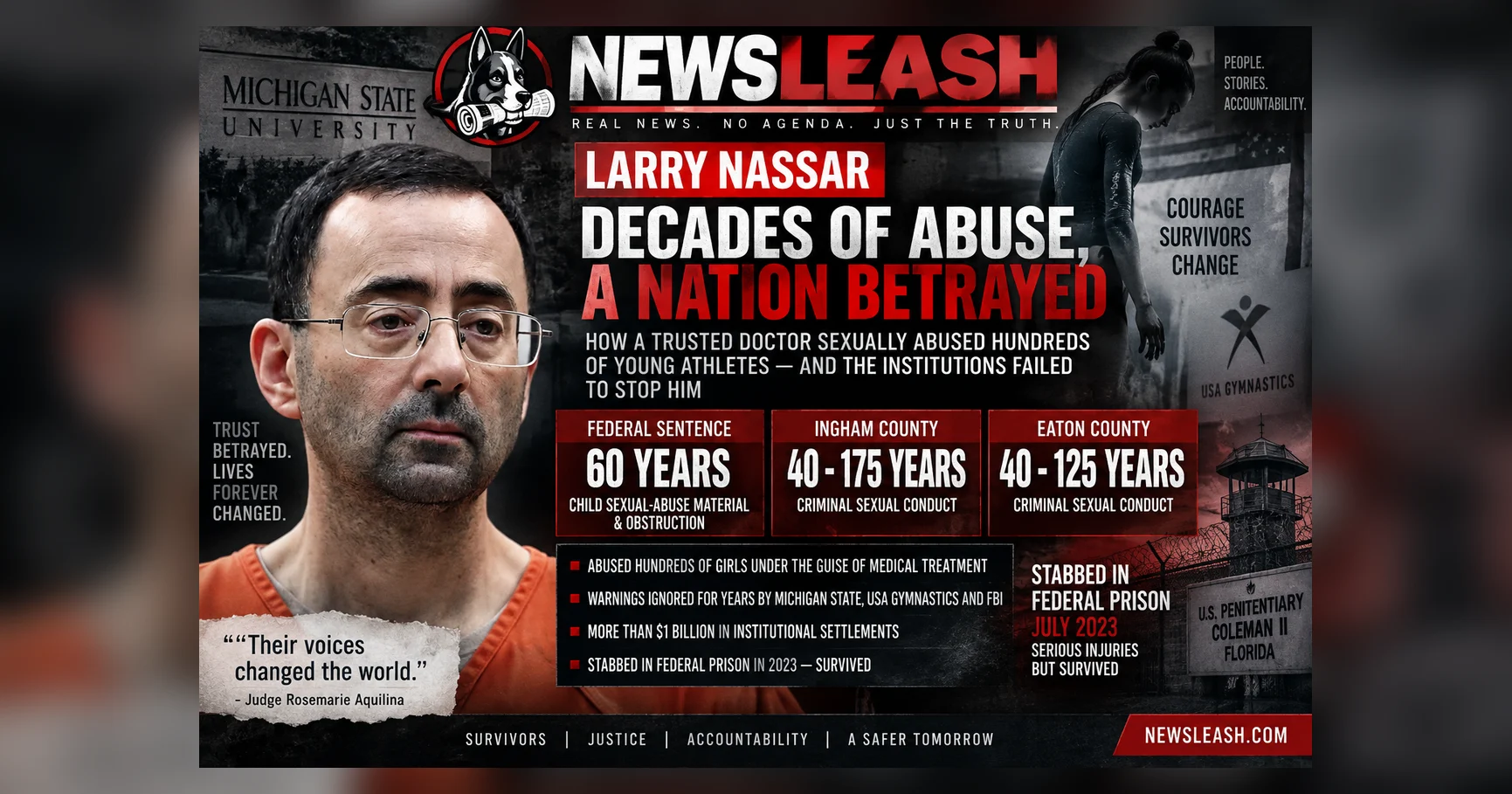
Lawrence Gerard “Larry” Nassar, the former USA Gymnastics and Michigan State University doctor who sexually abused hundreds of girls and women under the guise of medical treatment, will spend the rest of his life in federal prison — the result of a case that exposed institutional failures at Michigan State, USA Gymnastics and the FBI, and produced more than $1 billion in settlements.
Years of warnings before an arrest
Nassar’s abuse continued for years in part because the institutions around him failed to act on warnings. A Michigan Attorney General investigation that interviewed 280 survivors found 13 had reported Nassar’s conduct to an identifiable Michigan State employee at or near the time it occurred, with reports dating back to 1997. The most consequential missed opportunity came in 2014, when MSU student Amanda Thomashow reported that Nassar had assaulted her during a hip-pain appointment. The university’s investigation relied on medical experts with ties to Nassar rather than independent reviewers, concluded he hadn’t violated policy, and returned him to practice.
USA Gymnastics reported allegations to the FBI’s Indianapolis field office in 2015. A Justice Department Inspector General investigation later found the office failed to respond with appropriate urgency — delaying investigative steps, interviewing only one of three available athletes, and never properly notifying Michigan State University Police or the FBI’s own Michigan office, which didn’t learn of the allegations for more than a year, and only then through MSU police rather than its own agency.
The case becomes public
Former gymnast Rachael Denhollander reported to MSU police in 2016 that Nassar had assaulted her at age 15. The Indianapolis Star published allegations against him that September, and Michigan State fired him Sept. 20, 2016. Michigan’s attorney general announced criminal sexual-conduct charges that November.
A separate federal investigation of Nassar’s devices turned up roughly 37,000 images of child sexual abuse material. He pleaded guilty in July 2017 to federal charges of receiving and possessing the material and of destroying evidence once he realized investigators were closing in; a federal judge sentenced him to 60 years in December 2017.
On the state side, Nassar pleaded guilty to seven counts of first-degree criminal sexual conduct in Ingham County in November 2017 and three more in Eaton County days later, admitting the conduct was sexual rather than medical. His January 2018 sentencing hearing in Ingham County became a defining moment of the case: more than 150 survivors addressed the court over several days before Judge Rosemarie Aquilina sentenced him to 40 to 175 years. An Eaton County judge added 40 to 125 years the following month — sentences that, stacked on the federal term, ensure Nassar will not leave custody alive.
What the money represents
The scandal’s financial toll reflects the scale of institutional failure as much as the abuse itself. Michigan State agreed in 2018 to a $500 million settlement covering 332 survivors. USA Gymnastics, the U.S. Olympic & Paralympic Committee and their insurers settled for $380 million in 2021. In 2024, the Justice Department paid $138.7 million to resolve 139 claims that the FBI failed to adequately investigate the original allegations — a rare instance of the federal government compensating victims for its own agents’ inaction. Combined, the three settlements exceed $1 billion.
Attacked in prison
Nassar was moved in 2018 to USP Coleman II, a high-security federal prison in Florida. In July 2023, another inmate stabbed him repeatedly in the neck, chest and back, collapsing a lung; Nassar survived after emergency treatment. Reports citing people familiar with the incident said it followed a remark Nassar allegedly made while inmates watched Wimbledon — a detail that has not been independently confirmed as the motive and should be treated as an allegation, not an established fact.
Where things stand
Nassar is serving his sentences at a federal facility and is expected to remain in custody for the rest of his life. His Michigan medical license has been permanently revoked. The case remains a reference point for how institutions — a university, a national sports governing body, and the FBI itself — can fail the people they’re responsible for protecting, even after repeated warnings.