
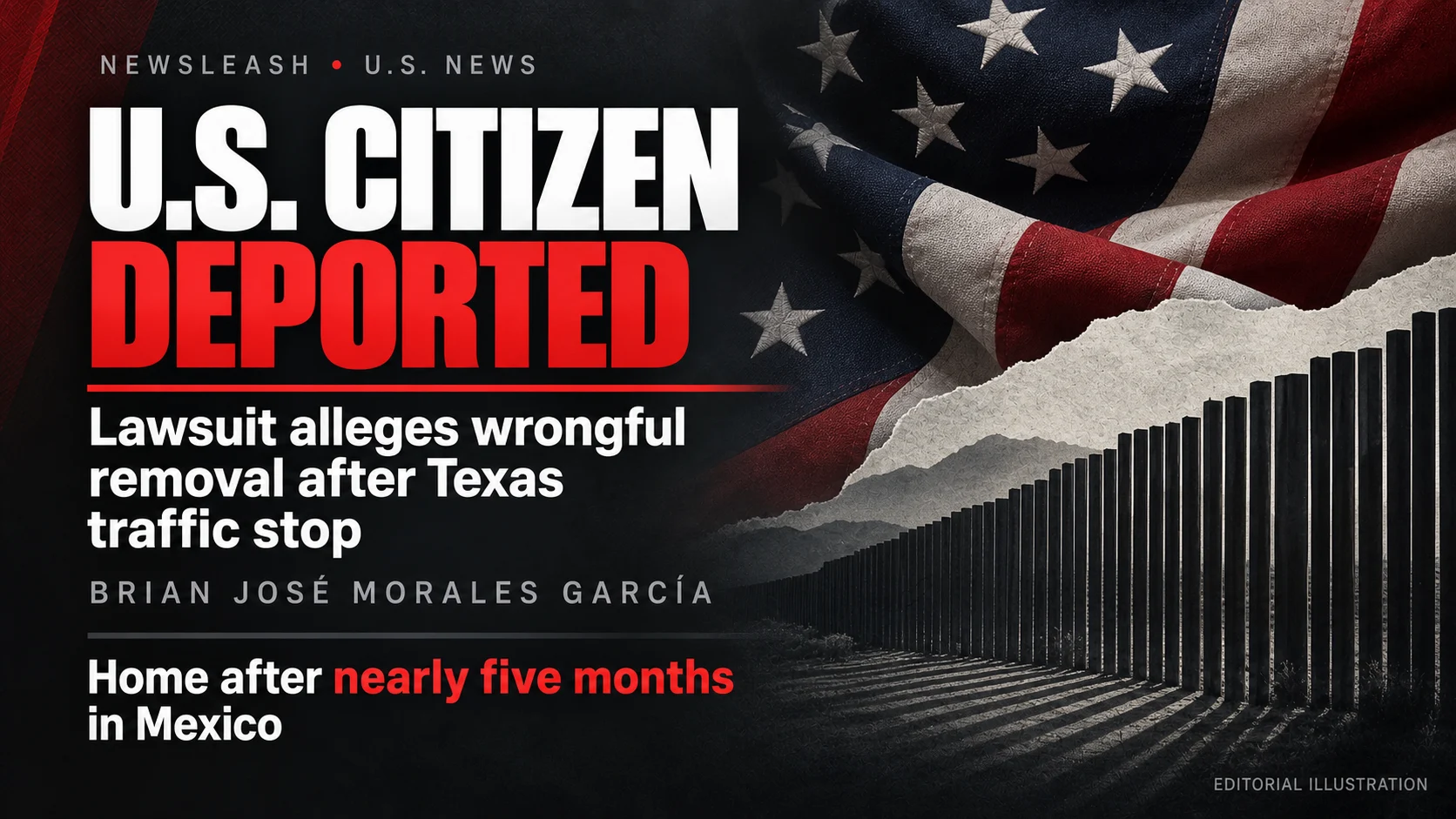
A U.S. citizen born in Denver, Colorado, was detained after a Texas traffic stop and deported to Mexico in April, according to a federal lawsuit filed on his behalf. Brian José Morales García, 25, spent nearly five months outside the country before he was allowed to return home, his attorney said.
According to the lawsuit, Morales García was riding as a passenger in his employer’s pickup truck on April 3 when Texas Department of Public Safety troopers stopped the vehicle near Fredericksburg for an alleged window tint violation. No one in the truck was issued a citation as a result of the stop, said his attorney, Kate Lincoln-Goldfinch.
Morales García told the troopers, and later Gillespie County sheriff’s deputies called in to translate, that he was a U.S. citizen born in Denver and asked for a chance to retrieve his documents, Lincoln-Goldfinch said. Instead of releasing him, officers contacted U.S. Immigration and Customs Enforcement, which instructed them to hold Morales García and another passenger, the lawsuit states. He was then booked into the Gillespie County Jail. Both the Texas Department of Public Safety and the Gillespie County Sheriff’s Office have formal partnerships with ICE that allow local officers to assist with federal immigration enforcement.
Over the following four days, Morales García was moved through a series of detention facilities before being transferred into U.S. Customs and Border Protection custody. According to his attorney, CBP agents dismissed his repeated claims of U.S. citizenship and told him he could face up to five years in prison if he continued to make them.
“At that point, he’d been abused for four days straight, and he believed that he was going to either sign the paperwork they told him to sign or go to jail for years,” Lincoln-Goldfinch said. “So he signed these documents … under duress.”
By signing the documents, Morales García agreed to be deported to Mexico. He was placed on a deportation flight on April 7.
Morales García was born in Denver in 2001 to Mexican parents, according to a birth certificate reviewed by USA TODAY. He was baptized later that year at a Catholic church in Aurora, Colorado, where church records also list Denver as his birthplace, and he holds a Social Security card without work-authorization restrictions, records reviewed by USA TODAY show. His family returned to Mexico in 2002, and he grew up there, eventually marrying and starting a family. He came back to the United States in January 2025 to find work, driving from Aguascalientes, Mexico, and showing his Colorado birth certificate to a Customs and Border Protection officer at the port of entry before being allowed through. He later settled in Austin and worked a series of construction jobs, including installing air-conditioning units, before the April traffic stop.
The Department of Homeland Security did not respond to USA TODAY’s requests for comment. The Department of Justice declined to comment on the case, citing pending litigation. In court filings, however, the government said Morales García told federal agents he was born in Mexico and chose freely to return there — an account his attorney disputes.
Federal regulations generally require that unresolved claims of U.S. citizenship made during immigration proceedings be referred to immigration court rather than resolved through removal, and ICE policy calls for officers to consult supervisors and legal counsel and document their findings when a detainee’s citizenship is in question. If evidence suggests a person may be a U.S. citizen, agency guidance generally calls for release while the claim is investigated.
Morales García’s case is one of a number that researchers and government watchdogs say illustrate long-standing gaps in how immigration authorities verify citizenship claims. A 2021 Government Accountability Office report found that ICE arrested 674 potential U.S. citizens, detained 121 and deported 70 between fiscal year 2015 and early fiscal year 2020, with the majority of deportations occurring during President Donald Trump’s first term. The report also found that ICE did not consistently track such cases, making the true number of citizens caught up in the system impossible to determine. One study cited in the reporting estimated U.S. citizens make up as much as 1.5% of all deportees.
“This is a system that is advancing with less accountability now than before,” said Jacqueline Stevens, a political science professor at Northwestern University and founder of the school’s Deportation Research Clinic. “And less oversight because they’re not producing the records that they should be producing on these cases.”
Lincoln-Goldfinch said the case reflects a broader pattern she has seen in the field. “There’s no law in this country that says that U.S. citizens have to have ID on them when they’re going out or riding as passengers in a car,” she said. “What’s happening in the streets is that DPS, ICE and all the sheriffs are just stopping people with brown skin and asking them what their status is, and if they don’t have an answer that they like, they’re taking them. And it’s quiet and it’s silent what they’re doing, but it’s a slippery slope.”
Morales García ultimately returned to the United States after his attorneys filed a federal lawsuit challenging his removal. No criminal charges have been reported against Morales García in connection with the case; the litigation instead concerns the circumstances of his detention and deportation. The lawsuit remains pending, and the Department of Justice has said it will not comment further while the case is in litigation.
Source: USA Today